Here is a breakdown of why this asset class is booming, which sizes are leasing quickly, and which segments are taking a little longer to cross the finish line.
Why Small-Bay Flex Space Is Popular
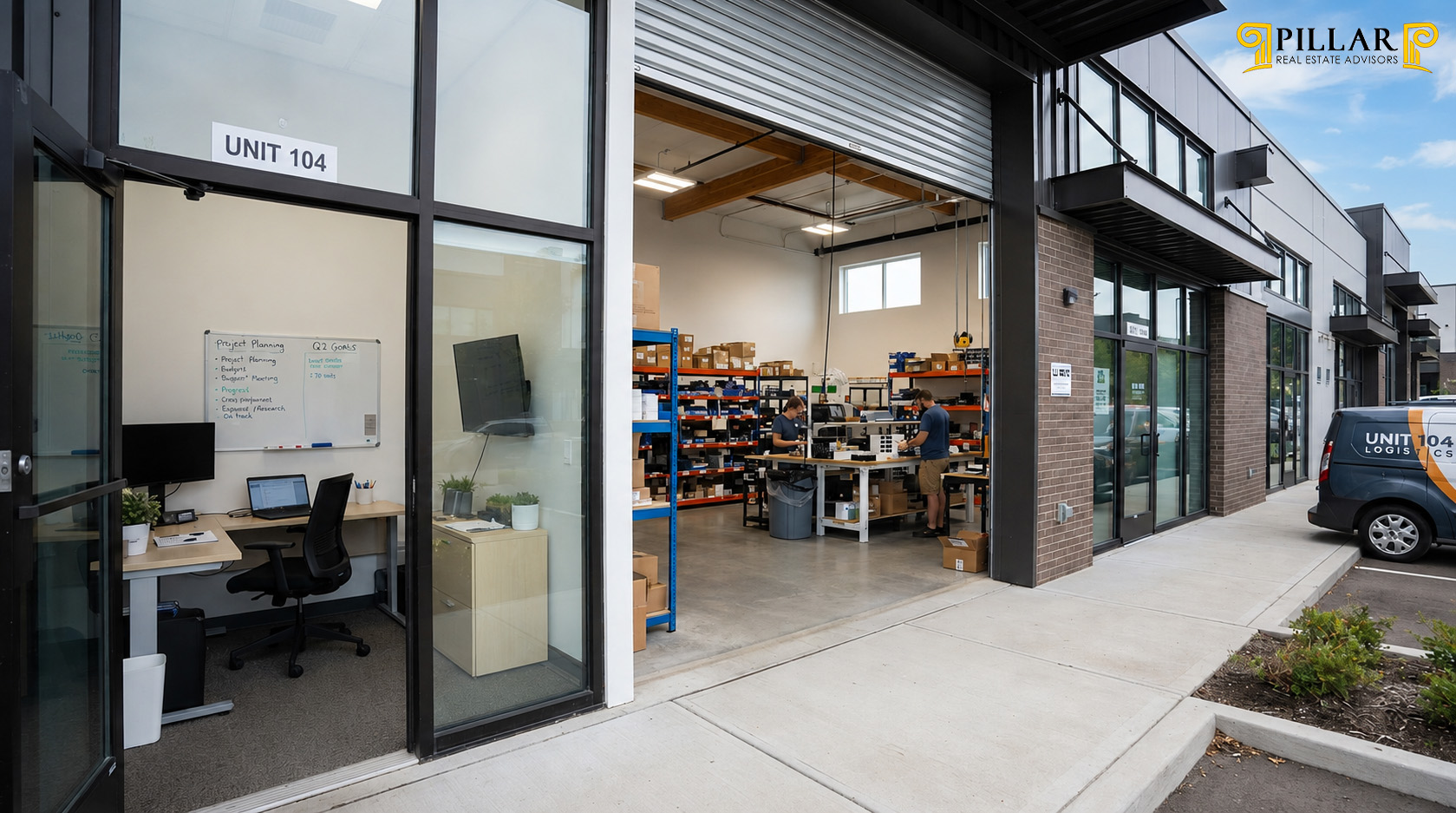
Small-bay flex space offers a level of adaptability that appeals to a wide range of businesses. A single unit can house a high-tech lab, a CrossFit gym, a contractor’s workshop, or an online boutique’s inventory management operation.
These spaces can also offer lower tenant turnover costs. Because they generally feature concrete floors, open warehouse layouts, and a modest office footprint, landlord build-out costs and tenant improvements between leases can be minimal compared to traditional corporate office spaces.
The Sweet Spots: Popular Sizes in Today’s Market
1,500 to 2,500 Square Feet: The Ultra-Light Industrial Hub
This is arguably one of the hottest segments in the market right now. These units typically offer a single drive-in, grade-level door, a small restroom, and just enough office space—typically 10% to 15% of the total footprint—to support administrative needs.
Local trade contractors, boutique e-commerce shops, and small distribution operations compete for this footprint because it provides the functionality they need while helping to minimize overhead.
3,000 to 5,000 Square Feet: The Growth Catalyst
This size range is highly sought after by rapidly expanding businesses that require a dedicated loading area, often utilizing a combination of a drive-in door and a shared loading dock.
It can accommodate a variety of users, including light manufacturing companies, regional medical equipment suppliers, and specialized tech repair firms that require separate administrative, showroom, and inventory areas.
The Slow Movers: Sizes Taking Longer to Lease
While the momentum behind the small-bay sector is undeniable, certain size thresholds and layout configurations are experiencing longer days on the market.
7,500 to 10,000 Square Feet: The “In-Between” Space
Units in this size range can face a bit of an identity challenge. They are often too large and expensive for local small businesses looking to step up from a 3,000-square-foot space, yet too small or height-restricted for major regional logistics and corporate distribution tenants that require 20,000+ square feet and 32-foot clear heights.
Landlords with these configurations may find themselves needing to subdivide the space into smaller bays to help accelerate leasing.
Heavy Office-Tilt Layouts: Any Size With More Than 40% Office Space
Regardless of the total square footage, flex spaces with legacy build-outs featuring sprawling, multi-room offices and minimal warehouse space can sit vacant longer. Today’s tenants often want high ceilings, clear-span warehouse floors, and loading capabilities.
If a 4,000-square-foot unit dedicates 2,000 square feet to static cubicles and conference rooms, modern industrial users may pass on it due to the amount of wasted footprint. At the same time, traditional office users may avoid it because of the industrial surroundings.
The Bottom Line
The commercial real estate market isn’t uniform, and small-bay flex space proves that agility can be a major advantage. By focusing development and leasing strategies on functional, easily divisible layouts between 1,500 and 5,000 square feet with minimal office overhead, landlords can capitalize on a high-demand sector that continues to appeal to a broad range of businesses.