Commercial real estate in 2026 is becoming increasingly selective. Instead of moving evenly across property types, capital and tenant demand are concentrating in certain segments while others face more pressure from vacancies, financing challenges, and shifting space needs.
This dynamic—often referred to as the “barbell effect”—helps explain the widening performance gap across asset classes and locations. Understanding where a property sits within this environment has become increasingly important for owners, investors, and tenants making long-term decisions.
What the Barbell Effect Means
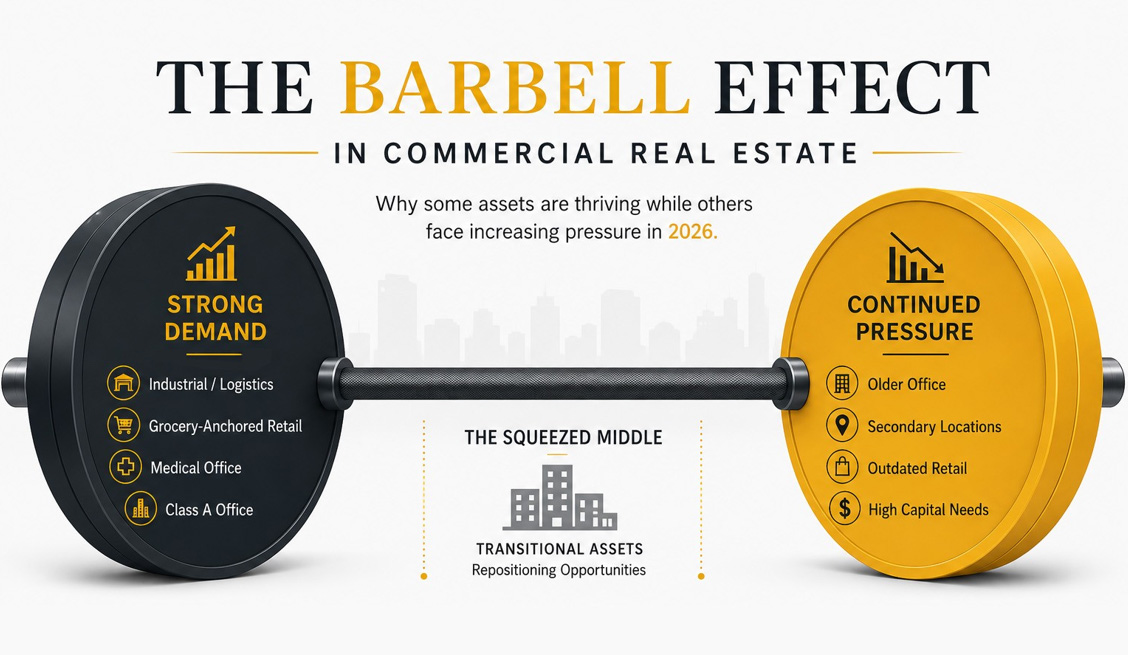
The barbell effect describes a market where strength is concentrated at two ends, while the middle becomes more competitive and less consistent.
In commercial real estate, this generally looks like:
- Strong demand for high-quality, well-located, or essential-use assets
- Continued pressure on older or functionally challenged properties
- A narrowing middle segment where performance depends heavily on pricing, condition, and repositioning potential
Rather than broad market movement, outcomes are increasingly driven by asset-specific fundamentals.
Where Demand Is Strong—and Where Pressure Remains
On the stronger side of the market, high-quality and newer assets continue to attract consistent demand. These properties benefit from lower capital needs, efficient layouts, strong tenant retention, and flexibility to meet evolving space requirements.
Industrial and logistics real estate also remains one of the most resilient sectors, supported by e-commerce growth and ongoing supply chain realignment. In Pennsylvania, this strength is especially visible throughout the Lehigh Valley and key regional logistics corridors.
Grocery-anchored and necessity-based retail continues to outperform, driven by stable tenants, consistent traffic, and limited new supply. At the same time, select Class A office properties remain competitive when they offer modern amenities, strong accessibility, and high-quality tenancy, though demand is increasingly concentrated in top-tier buildings.
On the other side of the market, older office assets and secondary suburban office properties continue to face pressure. Higher vacancy, increased capital requirements, and shifting workplace strategies have made these assets more challenging to lease and finance. In many cases, owners are evaluating repositioning or alternative use strategies.
Non-core retail centers, particularly non-anchored or outdated properties, are also seeing softer demand and often require reinvestment or redevelopment to remain competitive. Additionally, assets acquired during the 2021–2022 low-rate environment are increasingly facing refinancing pressure and valuation adjustments in today’s higher-rate capital markets.
The Pennsylvania Perspective
The barbell effect is especially visible across Pennsylvania’s diverse commercial real estate landscape.
More resilient segments include industrial properties in the Lehigh Valley and logistics corridors, grocery-anchored retail in established suburban markets, medical office and healthcare-related assets, and select newer multifamily developments.
More challenged segments include older suburban office corridors throughout Chester County and surrounding areas, legacy office stock in secondary locations, and non-anchored or outdated retail centers.
The Bottom Line
Commercial real estate is becoming more selective, with performance increasingly driven by asset quality, location, tenant strength, and capital structure rather than broad market trends.
The barbell effect highlights this divergence and reinforces the importance of understanding where a property sits within today’s environment when making leasing, investment, or disposition decisions.