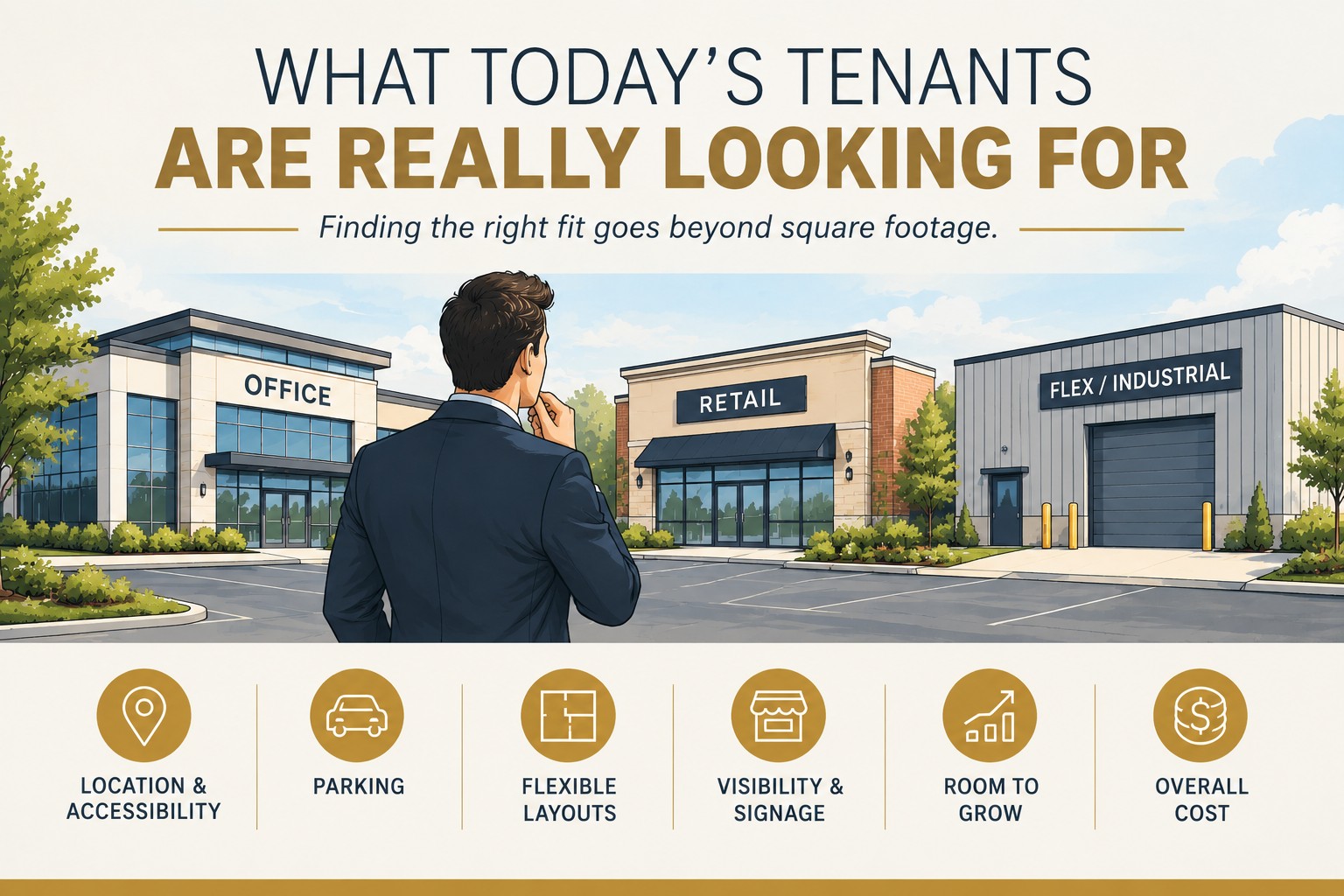
Finding the right commercial space is about more than square footage and rental rates. Today’s businesses are evaluating properties based on how well the space supports their employees, customers, daily operations, and long-term growth.
From location and parking to flexible layouts and signage, here are some of the factors tenants should consider when evaluating their next commercial space.
Location & Accessibility Still Matter
A convenient location can have a significant impact on how a business operates. Proximity to major highways, accessibility from surrounding communities, traffic patterns, and ease of entry and exit are all important considerations.
For customer-facing businesses, accessibility can directly affect how easily customers find and reach the property. For office and industrial users, a convenient location can also make a difference for employees, vendors, and deliveries.
A property may check every other box, but if it is difficult to access, it may not be the right fit.
Parking Needs to Work for the Business
Parking requirements vary depending on the type of business and how the space will be used.
An office with primarily employees may have different parking needs than a medical practice, retail business, or service provider with regular customer traffic. Tenants should consider the number of available spaces, peak parking demand, accessibility to the building, and whether parking is shared with other tenants.
Adequate parking is one of those features that can easily be overlooked during a property search but can become a major issue once a business is operating.
Flexible & Functional Space
Tenants are increasingly focused on how efficiently they can use the space—not simply how much space they are getting.
For office users, that could mean a combination of private offices, conference rooms, open workspace, and common areas. For industrial and flex users, functionality may come down to loading capabilities, ceiling height, drive-in access, warehouse-to-office ratios, and overall floorplan efficiency.
A well-designed space can often provide more value than a larger property with an inefficient layout.
Visibility & Signage Opportunities
For businesses that rely on customers visiting their location, visibility can be a major consideration.
Signage opportunities, frontage along a busy roadway, monument signage, and the ability to clearly identify the building can all help establish a business’s presence.
Even businesses that do not depend heavily on walk-in traffic can benefit from professional signage that makes the property easy for customers, clients, vendors, and employees to find.
Move-In Ready or Ready to Customize?
Not every tenant is looking for the same level of finish.
Some businesses want a move-in-ready space that requires little work before they can begin operations. Others may prefer a more basic space that allows them to customize the layout and finishes around their specific needs.
Tenants should consider not only the asking rent but also the potential cost and timeline associated with improvements. A space with a lower rental rate may require a significant build-out, while a more finished property may allow a business to move in much sooner.
Planning for Future Growth
The right space should work for the business today without creating problems tomorrow.
A growing company may quickly outgrow a space that only meets its current needs. At the same time, leasing substantially more space than necessary can result in higher occupancy costs without providing an immediate benefit.
Considering potential growth, expansion options, and the length of the anticipated lease can help businesses find a space that makes sense for both their current and future needs.
Look Beyond the Asking Rent
Rental rate is an important part of any commercial lease, but it is not the only cost to consider.
Depending on the property and lease structure, tenants may also be responsible for utilities, common area expenses, taxes, insurance, maintenance, and other operating costs. Build-out expenses and moving costs can also have a significant impact on the overall cost of a new location.
Looking at the total cost of occupancy provides a more complete picture when comparing different properties.
The Right Space Is About More Than Square Footage
The right commercial property is not necessarily the largest, newest, or least expensive option. It is the property that fits the way a business operates and provides the location, functionality, accessibility, and flexibility needed to support its goals.
For businesses searching for their next location, looking beyond square footage and asking rent can help identify a space that is a better fit for both today’s needs and tomorrow’s growth.